Pheidole is a species of ant in the subfamily Myrmicinae. It is mostly found in eastern Asia.
Myrmicinae is a subfamily of ants, with about 140 extant genera; their distribution is cosmopolitan. The pupae lack cocoons. Some species retain a functional sting. The petioles of Myrmicinae consist of two nodes. The nests are permanent and in soil, rotting wood, under stones, or in trees.
Myrmicine worker ants have a distinct postpetiole, i.e., abdominal segment III is notably smaller than segment IV and set off from it by a well-developed constriction; the pronotum is inflexibly fused to the rest of the mesosoma, such that the promesonotal suture is weakly impressed or absent, and a functional sting is usually present. The clypeus is well-developed; as a result, the antennal sockets are well separated from the anterior margin of the head. Most myrmicine genera possess well-developed eyes and frontal lobes that partly conceal the antennal insertions.
—Wikipedia
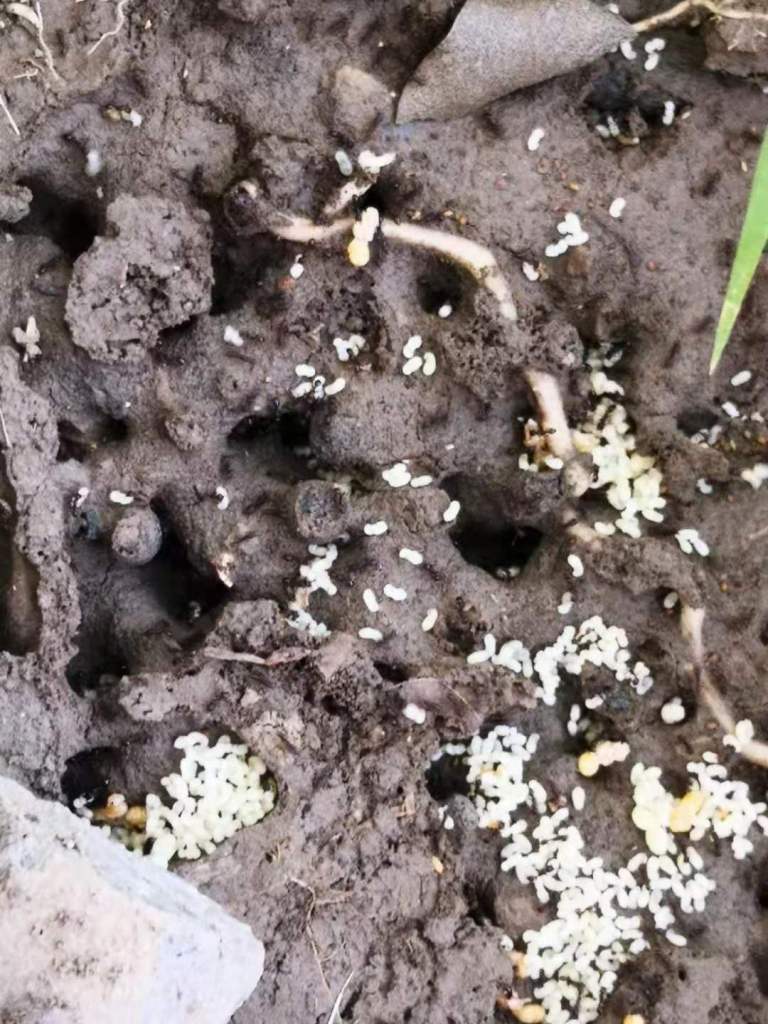
This ant nest was photographed near Binjiang Park, Minhang District, Shanghai on 2020/9/13. I just casually flipped over a rock and the nest was exposed. The white grain-like objects in the photo are the chrysalises of the worker ants while the larger brownish grain-like objects are the chrysalises of the queen ants, as ant nests can have multiple queens to maintain a sustainable population. I identified these ants as Pheidole through their soldier ants(unfortunately, there were only a few soldier ants and I didn’t manage to get them in the photo), as in Shanghai there are mainly three types of ants which have soldiers, Pheidole noda Pheidole pieli and Pheidole zoceana, with the latter two having relatively lighter colors. However, since the picture is kind of blurry and the ants have relatively different colors, I couldn’t recognize them specifically. After the photograph was taken, the ant nest was covered back up in order to prevent it from being overdamaged.
 站点标题
站点标题 